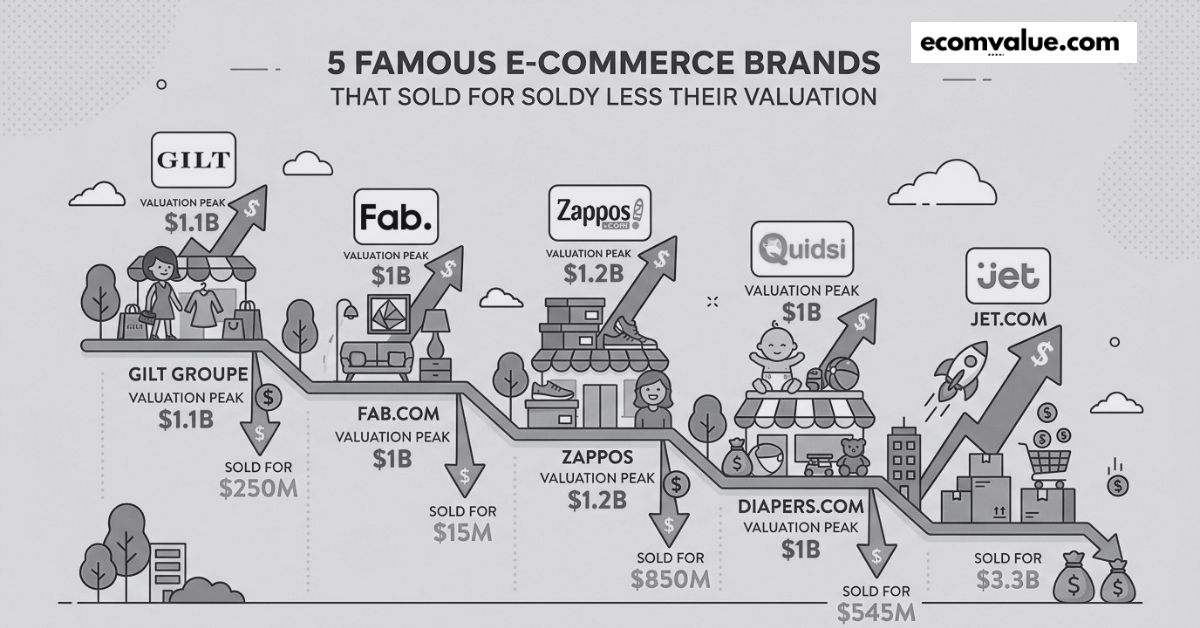
In 2011, Gilt Groupe was the hottest name in online fashion. Investors valued it at over $1 billion. Five years later, it sold for $250 million, roughly a quarter of that peak number. The investors didn’t get what they expected. The buyers got a deal.
Stories like this happen more often than people think. A brand raises massive funding, gets a sky-high valuation, then quietly sells for far less when the market stops believing the story. And what makes it worth studying is this, the gap between a valuation and an actual sale price tells you a lot about how website and business value really works.
If you’ve ever wondered what your own website or online store might actually be worth (not what someone thinks it could be worth someday, but what a real buyer would actually pay today), these five stories are a good place to start. You can also run your own numbers through EcomValue’s free website worth calculator to get a real-world estimate based on traffic, revenue, and industry multiples.
The Numbers at a Glance
Here’s a quick view of the five brands, what they were valued at, and what they actually sold for.
| Brand | Peak Valuation | Acquisition Price | Acquired By | Year | Discount From Peak |
|---|---|---|---|---|---|
| Gilt Groupe | $1.1 billion | $250 million | Hudson’s Bay Co. | 2016 | ~77% below peak |
| Fab.com | ~$1 billion | ~$15–50 million | PCH International | 2015 | ~95–98% below peak |
| Zappos | ~$850M–$1B (IPO estimate) | $1.2 billion (final close) | Amazon | 2009 | At or near estimated range |
| Diapers.com (Quidsi) | ~$300–$400M revenue run rate | $545 million | Amazon | 2010 | Above funding rounds but under growth potential |
| Jet.com | Raised $565M+ in VC | $3.3 billion | Walmart | 2016 | Brand wound down within 4 years |
Note on Zappos and Jet.com: Zappos actually sold at or above its IPO range estimate, so it belongs here for a different reason, Amazon then ran it as a money-losing side project for years. Jet.com sold for $3.3B but was shut down just four years later, making the acquisition price look like a poor deal in hindsight. The acquisition price versus lasting value is what matters.
1.) Gilt Groupe – The Flash Sale That Faded
Gilt Groupe launched in 2007 with a sharp idea. Sell luxury fashion at steep discounts, but only for a few hours at a time. Flash sales felt exciting and exclusive, and it worked brilliantly for a while.
By 2011, Goldman Sachs, SoftBank, and others had pushed Gilt’s valuation to $1 billion. The company was seen as the future of online fashion retail.
But the model had a flaw. Once other retailers copied the flash sale format, the excitement faded. Customers started waiting for sales instead of paying full price anywhere. Gilt could never close the profitability gap, and the IPO everyone expected never happened.
In January 2016, Hudson’s Bay Company (owner of Saks Fifth Avenue) bought Gilt for $250 million in cash. That’s 77% below its peak valuation.
What went wrong: Gilt’s model was clever but not defensible. When discounting becomes industry-standard, your moat disappears. The valuation was built on hype and growth projections. The acquisition price reflected actual, current business performance.
2.) Fab.com – From $1 Billion to $15 Million in 18 Months
This one is the most dramatic on the list.
Fab.com raised $310 million in venture capital from names like Andreessen Horowitz and Mayfield Fund. In mid-2013, the company was valued at close to $1 billion. Eighteen months later, it was reportedly selling for somewhere between $15 million and $50 million to PCH International, an Irish manufacturing company.
That’s a collapse of 95–98% from peak valuation. For context, that’s the equivalent of your house being “worth” $1 million on paper, then selling for $20,000.
The company had burned through cash trying to expand from a curated design goods site into a full-scale e-commerce retailer. It entered new markets, built warehouses, hired fast, and pivoted hard. Each pivot added costs and removed focus.
What went wrong: Fab had a great brand in a niche. When it tried to become everything to everyone, it lost both identity and money. The operational costs of running inventory-heavy e-commerce are brutal, and growth without profit margin is just spending.
3.) Zappos – A Different Kind of “Below Valuation” Story
Zappos is the odd one on this list, because the acquisition price was actually at or near what financial advisors estimated. Morgan Stanley had projected an IPO value of $650 million to $905 million for Zappos, and the Amazon deal closed at around $1.2 billion based on Amazon’s final stock price.
So why is it here?
Because Zappos CEO Tony Hsieh later said he didn’t want to sell. The company was on a path to IPO. The $1.2 billion exit felt like a ceiling, not a reward, and for the investors who came in at high valuations, it was a modest return.
Zappos had $625 million in net revenue in 2008 and $1 billion in gross merchandise sales. On those numbers, a buyer paying $1.2 billion was paying roughly 2x annual revenue which is actually a conservative multiple for a fast-growing e-commerce brand with strong customer loyalty.
The lesson here: Even when the numbers look okay on paper, if a company was trending toward an IPO at a potential higher valuation, the acquisition price can represent a below-potential exit. Zappos was probably worth more if given time.
4.) Diapers.com (Quidsi) – The Acquisition Amazon Forced
This story is less about bad decisions at Quidsi and more about what happens when a giant competitor decides it wants to buy you on its terms.
Quidsi ran Diapers.com, Soap.com, and BeautyBar.com. By 2010, it was running at a $300 million annual revenue run rate and growing fast. Amazon was so threatened by Diapers.com that it reportedly cut its own diaper prices to below cost just to pressure Quidsi’s margins and weaken its negotiating position.
Quidsi had actually approached Walmart first, but those talks fell through. Amazon then acquired Quidsi for $545 million in total – $500 million in cash plus $45 million in assumed debt.
Was this fair value? The $545 million was actually higher than Quidsi’s most recent funding round valuation. But given the $300M revenue run rate and explosive growth trajectory, a buyer paying 1.8x annual revenue was getting a steep deal especially since Amazon shut the sites down entirely by 2017.
What went wrong: Quidsi got caught in a price war it couldn’t win. When Amazon controls pricing in your category, your options shrink fast. The acquisition was more of a strategic exit under pressure than a true market-rate deal.
5.) Jet.com – The $3.3 Billion That Was Worth Nothing Four Years Later
Jet.com raised $565 million in venture capital and was one of the fastest-growing e-commerce startups in U.S. history. Walmart bought it in August 2016 for $3.3 billion, the largest e-commerce acquisition at that time.
By May 2020, Walmart had wound the Jet.com brand down entirely.
So while the acquisition price was not technically “below valuation,” the outcome means Walmart paid $3.3 billion for technology, talent, and a customer base it could have built differently. The Jet.com brand, the thing that justified the premium price, ceased to exist.
Jet.com was not profitable at the time of acquisition, and the CEO was not projecting profitability until 2020 at the earliest. Walmart essentially paid a massive growth premium for a company that was still spending far more than it earned.
What went wrong: The valuation was based on momentum and strategic value, not fundamentals. When the acquirer integrates the brand and kills it, the “value” was the team and tech, not the business itself. That’s a very different thing.
What These Numbers Actually Mean for Website Valuation
These brands were valued using growth projections, market potential, and competitive narrative not current profitability. Real buyers (the ones writing actual checks) care about a different set of numbers. The most common business valuation methods used in acquisitions include profit multiples, revenue multiples, and discounted cash flow analysis.
Here’s how e-commerce businesses are typically valued when real money changes hands.
| Valuation Method | Formula | Typical Range | Best For |
|---|---|---|---|
| Monthly Profit Multiple | Monthly net profit × multiple | 20x–40x monthly profit | Small to mid-size e-commerce sites |
| Annual Revenue Multiple | Annual revenue × multiple | 2x–4x annual revenue | Established e-commerce brands |
| Traffic-Based Estimate | Monthly visitors × $0.10 baseline | Varies widely | Non-monetized or early-stage sites |
| SDE Multiple | Seller’s Discretionary Earnings × multiple | 2.5x–4x SDE | Profitable independent stores |
The brands above were valued using narrative and market potential. Most websites and e-commerce stores will be valued using actual, documented revenue and profit. That’s a good thing, it keeps expectations honest.
Common Mistakes That Lead to Overvaluation
Founders and sellers often repeat the same errors that led to these discounted acquisitions. These are the patterns worth recognizing early.
Confusing revenue with value. High gross revenue with thin margins does not translate to a high multiple. Buyers look at net profit, not top-line sales. Fab.com and Jet.com both had impressive revenue figures that hid serious cash burn.
Building for growth, not sustainability. When companies raise at high valuations, they feel pressure to match the growth narrative. They expand too fast, enter too many categories, and run costs up before revenue catches up.
Overestimating defensibility. Gilt’s flash sale model was easy to copy. Once it was copied industry-wide, Gilt’s moat disappeared. A business that can be replicated cheaply is not worth a $1 billion valuation, regardless of what investors paid.
Ignoring the acquirer’s agenda. Diapers.com found out that Amazon was not negotiating in good faith, it was manipulating the market to force a lower price. When your largest competitor becomes your buyer, the power dynamic is not equal.
Expecting the future to be priced in forever. Valuations based on “what this could be worth in five years” have an expiry date. If profitability doesn’t follow, the narrative collapses and so does the multiple.
What a Real Buyer Would Pay for Your E-commerce Site Today
The five brands above were dealing with VC-backed, high-growth situations. Most e-commerce websites are not in that category and that’s actually an advantage.
A site generating $5,000 per month in net profit, with stable traffic and a clean content structure, can realistically sell for $150,000 to $200,000 (30x–40x monthly net profit). That’s a real, documented, achievable number and not a narrative.
If you want to know where your own website stands, EcomValue’s free website worth calculator gives you a quick estimate based on the same metrics real buyers use – revenue, traffic, domain age, and monetization type. It won’t tell you what your site “could be worth” in a best-case scenario. It tells you what a realistic buyer would likely pay right now. That’s more useful.
Valuation Multiples by Business Type (For Reference)
| Business Type | Revenue Multiple (Annual) | Monthly Profit Multiple |
|---|---|---|
| E-commerce Store | 2x–4x | 20x–40x |
| SaaS / Subscription | 3x–6x | 40x–60x |
| Content / Ad-based | 2x–3.5x | 25x–40x |
| Affiliate Sites | 2x–3x | 25x–35x |
| Marketplace | 3x–5x | 30x–50x |
Final Thought
A valuation is an opinion. An acquisition price is a fact. The gap between those two numbers is where most founders learn their hardest lessons.
Gilt, Fab, Zappos, Quidsi, and Jet.com all had real products, real customers, and real revenue. What they didn’t always have was a business that matched what investors had priced in. When the gap between narrative and fundamentals gets too wide, the market corrects and sometimes brutally.
For anyone building or selling an e-commerce business today, the best starting point is knowing what you’re actually worth right now. Use the EcomValue website value estimator to get an honest, data-based number. Then build from there.