A college student started sending a weekly email to 10 of his classmates about business news. He wrote it in a tone his peers actually enjoyed reading. A few years later, that email newsletter had millions of subscribers and sold for $75 million. That newsletter was Morning Brew, and its story is one of the clearest examples of how an inbox audience can become a serious financial asset.
Most people think of newsletters as just content. But in 2026, the most subscribed ones in the world are businesses worth tens of millions of dollars, with valuations tied to subscriber count, engagement rates, and revenue. Let us look at the 10 biggest newsletters by subscribers, how they make money, and what they might actually be worth.
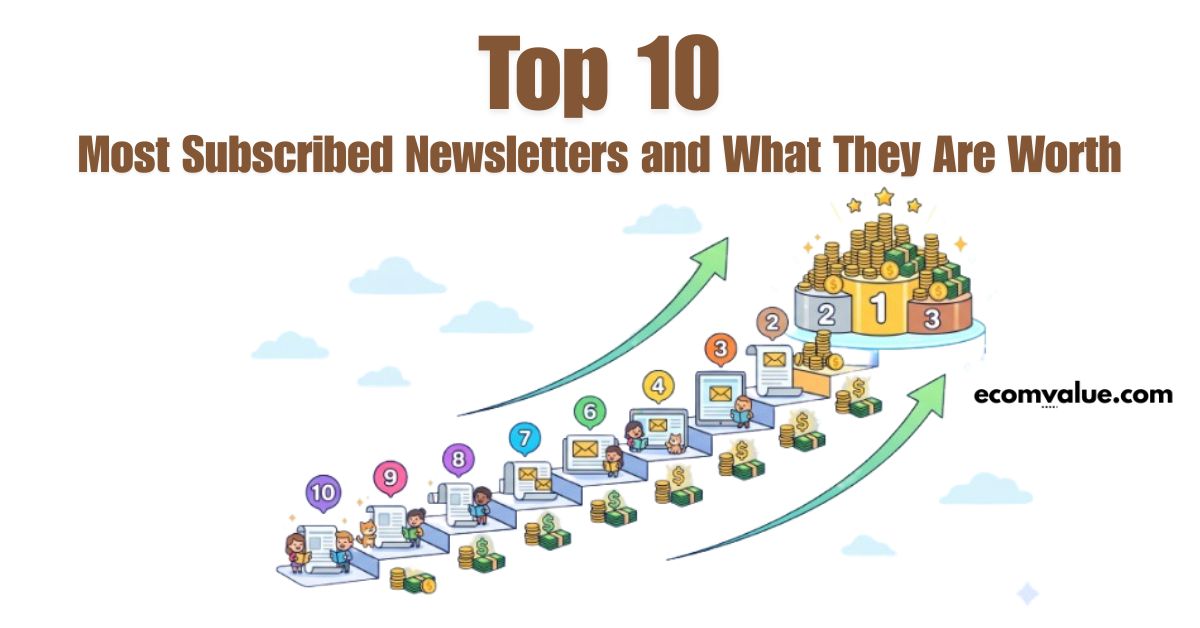
The 10 Most Subscribed Newsletters Right Now
1.) NYT’s The Morning – 17 Million Subscribers
The New York Times runs the most subscribed email newsletter in the world. “The Morning” delivers a daily summary of politics, culture, and global events to over 17 million readers, with roughly 8 million of those being paid subscribers. Given the NYT’s overall digital subscriber base of 12.21 million paying users and its bundled subscription model, the newsletter is a core driver of the company’s digital revenue. Estimating its standalone worth is difficult, but as an asset it represents hundreds of millions in annual subscription and ad revenue.
2.) The Skimm – 7 Million Subscribers
The Skimm was built for busy young professional women who want a quick daily news rundown. It grew to over 7 million subscribers and expanded into premium subscriptions, sponsored content, and partnerships. The Skimm has raised over $28 million in venture funding, and while it has not been acquired, its diversified monetization stack puts its estimated value in the range of $50 to $100 million based on standard media acquisition multiples.
3.) Morning Brew – 4 to 6 Million Subscribers
Morning Brew is arguably the most well-known newsletter brand in the creator economy. It was acquired by Insider Inc. for approximately $75 million in 2020, at a point when it had around 2.5 million subscribers. Today, with a readership estimated between 4 and 6 million across its newsletters, and annual revenue reported at over $70 million, it is one of the most valuable newsletter businesses ever built.
4.) 1440 – 3 Million+ Subscribers
1440 positions itself as a five-minute, politics-neutral daily news digest. It has grown past 3 million subscribers largely through referral programs and its no-opinion editorial style. The newsletter is heavily ad-supported and has attracted significant venture backing, placing its estimated valuation in the $20 to $40 million range based on revenue and growth rate.
5.) The Hustle – 2.5 Million Subscribers
HubSpot acquired The Hustle in 2021 for a reported $27 million. At the time of acquisition, it had around 1.5 million subscribers. Today the list sits at over 2.5 million, and its integration into HubSpot’s content strategy makes it one of the more strategically valuable newsletter assets in B2B marketing.
6.) TLDR – 1.2 Million+ Subscribers
TLDR is a free daily tech newsletter popular with software engineers and developers. It started as a side project and grew organically to over a million subscribers within a few years, primarily through word-of-mouth in tech communities. TLDR operates on a pure sponsorship model and given its highly technical audience, it commands some of the highest CPM rates in the newsletter space, ranging from $75 to $150+ per 1,000 subscribers. At those rates and with its subscriber count, TLDR is estimated to generate several million dollars per year in ad revenue.
7.) Axios AM – 1 Million+ Subscribers
Axios built a smart-brevity news format that has attracted over 1 million subscribers to its flagship morning newsletter. The company went public and was later acquired by Cox Enterprises for $525 million in 2022. The newsletter is a central piece of Axios’s media business and contributes significantly to its premium ad product.
8.) Lenny’s Newsletter – 600,000+ Subscribers
Lenny Rachitsky’s product and growth newsletter is one of the most successful paid subscriber publications on the internet. With over 600,000 total subscribers, including a significant base of paying members at $15 per month, Lenny’s Newsletter is estimated to generate $5 to $10 million or more in annual revenue. At standard SaaS-adjacent newsletter multiples of 10x to 20x annual revenue, its valuation likely sits in the $50 to $100 million range.
9.) The Browser – 75,000+ Paid Subscribers
The Browser is a curated reading newsletter that recommends articles from around the web. It is entirely paid-subscription, no ads. With a subscriber base of roughly 75,000 paying readers, The Browser earns several million dollars per year in subscription revenue and is a strong example of how niche, high-quality newsletters can be deeply profitable without scale.
10.) Stratechery – Premium Subscriber Base
Stratechery by Ben Thompson is one of the most influential technology strategy newsletters in the world, read by CEOs, investors, and senior tech professionals. At $15 per month for daily access, even a conservative estimate of 30,000 to 50,000 paid subscribers implies $5 to $9 million in annual recurring revenue. Given its institutional audience and influence, its valuation would sit well above typical multiples.
How Newsletter Value Is Actually Calculated
A high subscriber count does not automatically mean high value. This surprises most people. A newsletter with 20,000 highly engaged readers who open every email and click on links can be worth significantly more than one with 100,000 cold subscribers who never open anything.
The core formula most buyers use is straightforward. Newsletter valuation is typically calculated as monthly net profit multiplied by a multiple of 30x to 45x, which works out to roughly 2.5 to 3.75 times annual profit. For growth-stage newsletters, some buyers apply a higher multiple of 10x to 20x annual revenue if the list is growing fast month over month.
The main factors that push a newsletter’s value up or down are open rate, click-through rate, subscriber growth, platform portability, revenue source mix, and how dependent operations are on a single person. A newsletter that earns through both ads and paid subscriptions is worth more than one with a single revenue stream.
Sponsorship rates give you a sense of earning potential. Most newsletters charge advertisers on a CPM basis, meaning cost per 1,000 subscribers. General consumer newsletters charge $15 to $35 CPM. Marketing and business newsletters sit at $40 to $75. Finance, B2B, and professional newsletters can command $75 to $200 CPM or more.
So a 100,000-subscriber finance newsletter charging $100 CPM earns $10,000 per sponsorship placement. Run two placements per week and that is $1 million per year in ad revenue alone.
What the Big Acquisitions Tell Us
The three landmark newsletter acquisitions are Morning Brew at $75 million, The Hustle at $27 million, and Industry Dive at $525 million. Each of these deals shared common traits: strong engagement, niche authority, diversified revenue, and a clear audience identity.
Morning Brew was not just a big list. It had a 40% open rate at scale, which is exceptional. That open rate meant advertisers paid a premium because they knew the audience actually read the newsletter, not just received it.
The Hustle had a loyal founder-focused audience that HubSpot wanted for its content marketing strategy. The acquisition price was less about revenue and more about audience quality and strategic fit.
Industry Dive was different. It ran 26 vertical B2B newsletters across industries like healthcare, finance, and logistics. At $525 million, it showed that building a portfolio of niche newsletters can multiply value many times over compared to running a single general-interest one.
Things to Avoid When Thinking About Newsletter Value
Counting total subscribers without looking at engagement. A list of 500,000 subscribers with a 10% open rate is less valuable than a list of 100,000 with a 45% open rate. Always look at active readers, not just total count.
Assuming growth rate does not matter. A newsletter growing at 20% month-over-month will command a higher multiple because buyers are pricing in future revenue. Flat or declining lists lose valuation fast.
Ignoring platform risk. A newsletter stuck on a platform that owns the subscriber data is worth less than one where the creator fully owns and can export the list. Platform independence is a real valuation driver.
Treating all niches equally. A 10,000-subscriber finance newsletter for high-net-worth investors is worth more per subscriber than a 10,000-subscriber general lifestyle newsletter. Audience purchasing power matters enormously.
Over-indexing on subscriber count when pricing sponsorships. Advertisers increasingly care about click-through rates and audience demographics. Raw subscriber numbers without engagement data will get you turned down by quality sponsors.
Your Website Has a Value Too
Newsletters are a type of digital media asset, and so is your website. The same logic applies. Traffic, engagement, revenue, growth rate, and niche authority all shape what your site is actually worth. If you run a content site, a blog, or a web tool and you are curious about its estimated value, you can check it instantly using the free website worth calculator at EcomValue, no sign-up needed. It gives you a real-time estimate based on your domain’s traffic, ad revenue potential, and market benchmarks. It takes about 10 seconds.
Why This Matters Beyond the Numbers
The newsletter economy has crossed a point where email lists are no longer side projects. The New York Times counts its newsletters among its core digital products. Beehiiv reports that publishers on its platform sent 28 billion emails last year and reached over 255 million unique readers with open rates above 41%.
Owning an engaged audience through a newsletter is now one of the most defensible media assets a creator or company can build. Unlike social media followers, a subscriber list is portable, owned, and highly monetizable. That is exactly why the biggest ones are worth tens of millions of dollars, and why even small newsletters in the right niche can generate serious recurring income.